2025 was a foundational year for Status Network. The focus was on building and operating the core systems required for a gasless and privacy-preserving Ethereum Layer 2.
After receiving clear community support to launch an L2 with SNT staking its core, development concentrated on turning two explicit design constraints into running infrastructure: native gasless execution and privacy-first operation. Throughout the year, these constraints guided protocol design, application architecture, and ecosystem coordination.
By the end of 2025, Status Network was operating continuously on testnet, with its core execution, reputation, and economic systems architected and undergoing implementation on testnet v2 in preparation for mainnet.
Status Network is designed as a fully gasless Ethereum Layer 2. Transactions do not rely on user-paid gas fees, relayers, or subsidised paymasters. Removing gas required replacing its core functions: throughput allocation, spam protection, and transaction prioritisation.
This was implemented through a reputation-based execution model. Users transact using gas-free throughput quotas that scale with their Karma, the network’s non-transferable reputation token. Karma acts as a network-wide signal used to allocate access to block space without relying on transaction fees.
Spam protection and rate limiting are enforced using the Rate Limiting Nullifier (RLN), a cryptographic primitive developed and integrated into the protocol throughout the year. RLN enables transaction rate enforcement without linking activity to persistent identities or exposing normal user behavior. Only quota violations are surfaced, while compliant activity remains private.
To support this execution model, Status Network maintains a sovereign protocol codebase derived from the Linea zkEVM stack. Custom execution client extensions were built to support zero-fee transactions, along with a dedicated Rust-based RLN prover and sequencer coordination logic. These components were deployed, iterated, and stabilised while keeping compatibility with upstream Ethereum and Linea upgrades.
Testnet v1 ran continuously during 2025, validating gasless execution under real usage conditions. Testnet v2 focuses on full enforcement of RLN-based spam protection and final infrastructure hardening ahead of mainnet.
Privacy is treated as a baseline requirement across Status Network, not as an application-level feature.
Gasless execution plays a central role in reducing onchain traceability. Without gas fees, transaction patterns are no longer linked to account funding behaviour, gas price bidding, or fee-market participation. This removes a major source of activity correlation present on conventional L2s.
Reputation and governance systems were designed to minimise persistent identity exposure. Karma allows participation, throughput scaling, and governance influence without relying on transferable tokens or long-lived identity primitives. Funding and voting flows were structured to limit unnecessary linkage between accounts and historical activity.
Throughout 2025, systems were evaluated based on how they behave under real usage rather than theoretical privacy guarantees. In parallel, research progressed on native privacy primitives, including stealth address support and compliant private-yield assets, to extend privacy guarantees at the protocol and application layers over time and ultimately offer true composable privacy for all apps deployed on Status Network.
A gasless protocol requires an alternative economic model. Status Network replaces gas fees with a yield-backed system where bridged assets and native application fees generate sustainable funding for the network.
The Status Network Bridge and Status Network Hub were deployed as core infrastructure, designed to be non-custodial, censorship-resistant, and operable by third parties. A canonical offchain service layer (SN-API) supports official applications without introducing centralised control.
SNT staking contracts and the Karma reputation system were developed and audited on testnet. These systems preserve user ownership through immutable contracts and enable modular participation across applications.
Pre-deposit vaults were introduced as part of mainnet preparation, alongside a yield-bearing bridge architecture. Bridged ETH and stablecoins generate yield on Ethereum L1, which is redirected to the L2 and combined with fees from native applications. This approach preserves rollup security properties while establishing yield as the economic backbone of the network.
DeFi development followed the same principles, including collaboration on a new stablecoin and continued work on privacy-aware financial primitives compatible with gasless execution.
In 2025, Status Network engaged with developers by organising hackathons, technical events, and long-form discussions with builders interested in gasless and privacy-preserving infrastructure.
Tooling was released to reduce onboarding friction, including a dedicated Status Network Scaffold, Open RPC tooling, and experimental ecosystem gateways. These tools enable developers to deploy and test applications without requiring upfront capital or complex gas management.
Ecosystem coordination emphasised long-term alignment. Conversations with over 250 teams helped define infrastructure requirements, application pipelines, and launch readiness for mainnet. Incentives were structured around usage and yield rather than short-term airdrop dynamics.
Testnet experiments such as Karma Climber and Status Mines were used to validate onboarding, reputation distribution, and engagement mechanics ahead of broader ecosystem rollout.
Status Network continues to operate as a community-led project. In 2025, governance infrastructure was prepared to support capital allocation, ecosystem funding, and long-term stewardship.
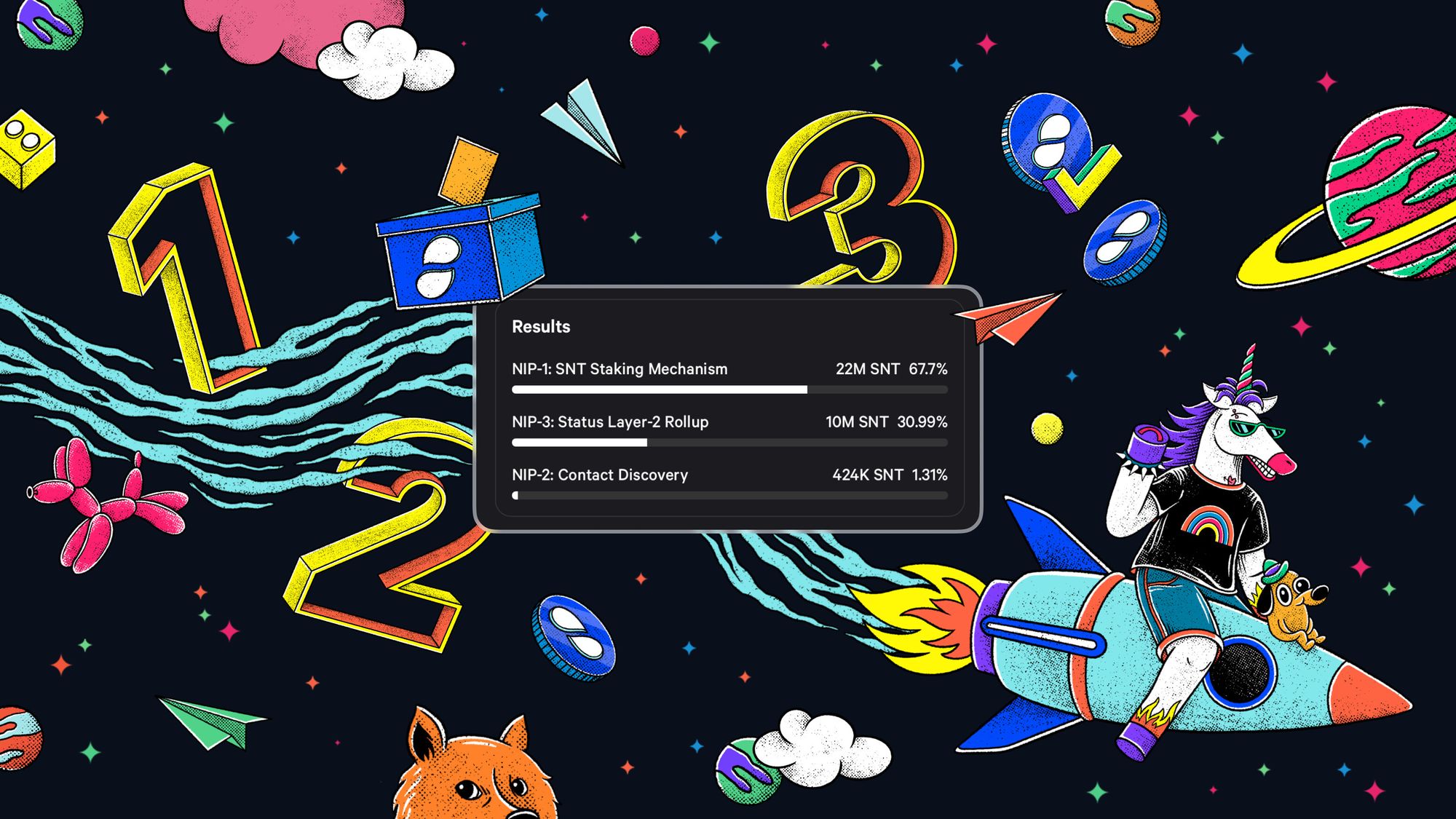
A community vote approved the activation of a limited portion of the Status Community Fund. Pre-deposit vaults for SNT, LINEA, ETH, and GUSD were introduced with governance oversight, reinforcing transparent participation in network bootstrapping.
Visual identity updates aligned Status Network more closely with the broader Status ecosystem, supporting clarity across products and communications.
By the end of 2025, Status Network was operating as a gasless Layer 2 on testnet with its core protocol, economic, and governance systems being improved upon.
Testnet v2 focuses on final implementation, infrastructure readiness, and ecosystem integration. Mainnet launch in 2026 continues the same trajectory: a network built around gasless execution, yield-backed economics, and privacy as a structural property.
Participation, governance, and ecosystem engagement are coordinated through Status Network Hub, which remains the primary entry point for users and builders preparing for mainnet.