Devconnect, Revisited: What we shared, what we learned, what we’re building

Two months after Devconnect, the conversations from that week still shape how we think about Ethereum’s next phase. Devconnect was not treated as a moment for announcements, but as a place to test ideas in public, across different audiences, formats, and levels of scrutiny.
At Devconnect 2025, Status Network presented a model for Ethereum L2 built around three core properties: a fully gasless execution layer, native yield at the protocol level, and composable, opt-in privacy.
Across a week of keynotes, panels, and hands-on conversations, the team showed how gasless execution, reputation-based access, and yield-powered infrastructure work together not as isolated concepts, but as a system that lets users and builders start earning real power over the network from day one.
Cypherpunk Congress
The week started with Cypherpunk Congress, where we hosted a booth and joined panel discussions.
The discussion highlighted why Status Network is building privacy as a full system, not just a feature. Cyp explained that on Status Network “there is no gas on the L2, it’s replaced by reputation,” which removes one of the biggest privacy leaks in blockchains.
As he put it, “there is no way to link the gas usage of an address with another one,” and that makes real privacy possible. Instead of hiding transactions in isolated pools, Status is building “a composable privacy layer on top of the L2” that works with normal apps.
The takeaway was simple: privacy will scale when people can use it without thinking about it.


World’s Fair: the booth
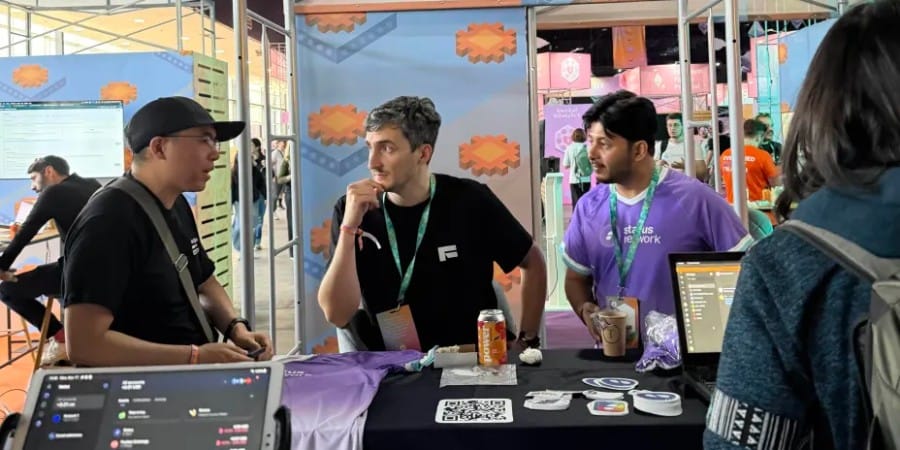
Across three days at the Devconnect World’s Fair, the Status booth became a place for practical conversations.
Many asked deep follow-up questions about Status Network’s seamless experience. Conversations repeatedly returned to two themes:
- what gasless transactions actually feel like,
- how opt-in privacy works without breaking DeFi composability,
The Keycard shell was displayed for people to try out, and its intuitive design and straightforward usage surprised many.

At the Stable Summit, Status Network took part in both panel discussions and a dedicated fireside chat with Aragon. The core argument presented was that most rollups struggle financially because gas fees trend toward zero, forcing networks to rely on unsustainable volume or inflationary incentives.
Cyp explained how Status Network approaches this differently: funding L2 execution through native yield generated by bridged assets and onchain activity, rather than charging users for every transaction.
During the Aragon × Status Network fireside, this idea was explored in detail:
- Stablecoins were framed as infrastructure, not just payment assets.
- Non-yield-bearing assets were described as “leaving money on the table.”
- Governance was repositioned as control over capital allocation, not token emissions.
As Cyp put it:
“If you adopt a non-yield-bearing stablecoin, you’re leaving money on the table and someone else is earning on your TVL.”
This wasn’t about incentives for the sake of incentives. It was about aligning execution, yield, and governance into a sustainable L2 model.
Fireside: Aragon x Status Network
At AdoptionCon, Cyp delivered a keynote titled “Privacy should be fun & seamless.”
The talk tackled a hard truth: privacy adoption hasn’t failed because people don’t care, it has failed because the experience is too complex, the language is intimidating, and the tooling assumes expert users.
Rather than enforcing privacy by default, the argument was for clear, opt-in privacy that is:
- easy to understand,
- frictionless to use,
- and embedded directly into wallets and apps.
The goal isn’t to turn everyone into a cryptography expert, but to give users meaningful choice without cognitive overhead.
Keynote "Privacy should be fun and seamless" with Cyp, lead Status Network
Status Network delivered another keynote on “Privacy should be fun and seamless,” reinforcing the same message for a broader Devconnect audience and tying together themes from earlier sessions.
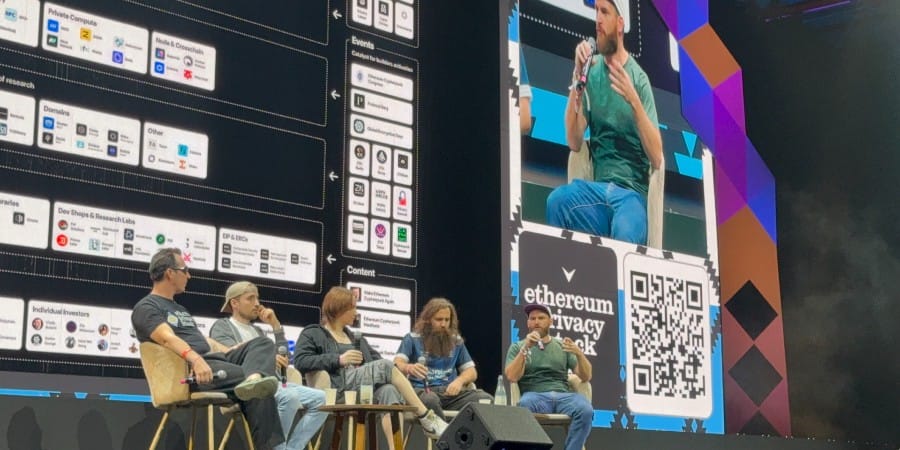
On the Ethereum Privacy Ecosystem Mapping panel, alongside Web3Privacy Now, Fluidkey, and other ecosystem contributors, the discussion zoomed out to the ecosystem level.
Key takeaways included:
- privacy is a stack, not a single tool,
- UX and language are as important as cryptography,
- privacy tools must be composable, like DeFi primitives,
- and privacy must move beyond a “hackery” or adversarial image.

Devconnect highlighted a quiet shift in the Ethereum privacy conversation.
The question is no longer whether privacy matters. The harder question is how privacy becomes normal infrastructure, rather than a specialised tool for advanced users.